

Beam Clamps - Guide for use
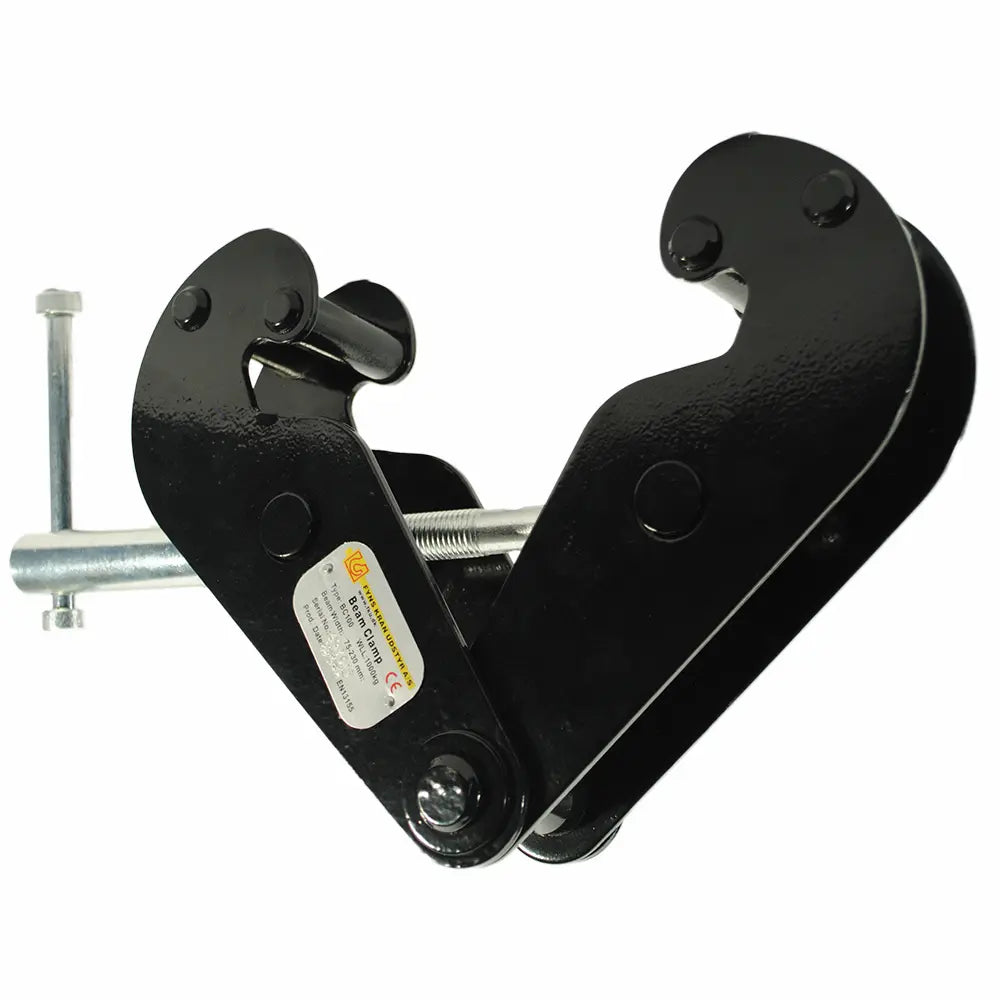
Beam clamps are particularly suitable for use in profiles to create an anchor point for, e.g., a hoist, as well as for lifting and moving profile beams. The operator must be familiar with the instructions for use and:
– Ensure that the weight of the load matches the capacity of the beam clamp.
– Ensure that the jaw opening of the beam clamp matches the size of the beam.
– Use a guide rope if there is a risk of the beam rotating.
– Do not perform unbalanced lifting with beam clamps.
– Only use the original handle to maneuver the spindle, as this can affect the torque.
– Do not expose beam clamps to extreme temperatures.
– Beam clamps can be used at temperatures between – 40˚C and +100˚C.
Before clamping, the weight of the load must be determined and any special instructions regarding handling of the load must be taken into account. Always ensure that the load is free-standing and not bolted or otherwise secured.
When lifting
1. Open the beam clamp using the handle on the threaded spindle.
2. Place the beam clamp on the beam in the desired position.
3. Close the jaws of the clamp tightly around the beam, ...and turn the handle on the threaded spindle. BY HAND ONLY!
4. Ensure that the clamp completely encloses the beam.
5. Secure the lifting device or load so that the lifting gear (e.g., hook/sling) is positioned in the center of the suspension bolt.
6. If the load is evenly distributed, begin lifting carefully.
7. When unloading, lower the crank hook until the beam clamp is fully unloaded – i.e. when the lifting chain is slack and the hook can move freely around the bolt on the beam clamp.
8. Remove the beam clamp by loosening the threaded spindle.
9. If a beam clamp is mounted in the same place for a long period of time, check regularly that the clamp is still securely fastened. Note: lifting capacity is reduced when lifting at an angle.
* When lifting at an angle greater than 45˚ from vertical, the WLL (Working Load Limit) is reduced by 50%.
