

Guide to Fall Protection
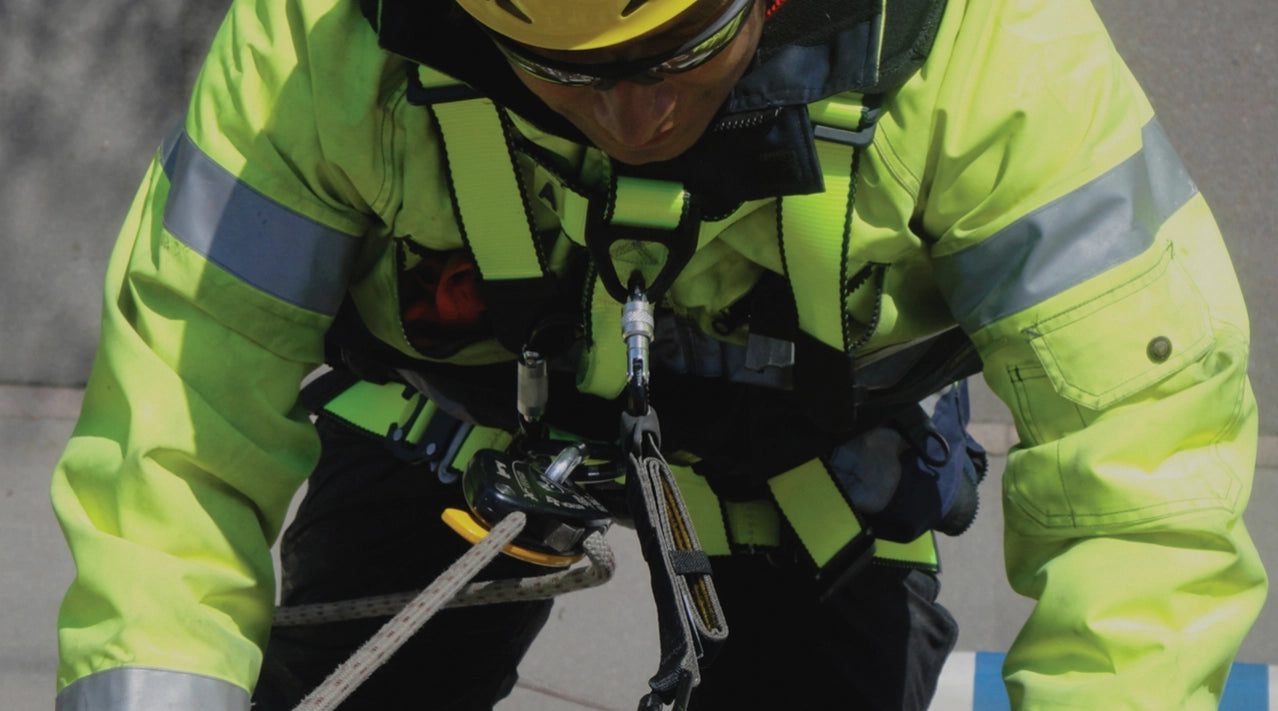
Among the most dangerous accidents in workplaces are those involving falls. In this letter, we would like to inform you about when and how fall protection should be used, as well as the requirements for labeling, etc.
What is fall protection equipment?
Fall protection equipment is defined as personal protective equipment that protects against falls. All parts used as fall protection equipment must be CE marked. In addition, the mark must be accompanied by a registration number for the independent testing institute responsible for ongoing quality control, and the properties must be tested in accordance with European standards. Furthermore, instructions for use must always be included.
It is the employer's responsibility to ensure that measures are in place to prevent falls during the performance of work. This could, for example, be scaffolding, the use of a lift, the installation of railings, or personal fall protection equipment, which may be used for short-term tasks where the work cannot otherwise be performed safely. Fall protection equipment must be used at the start of the work, throughout the work, and in the surrounding work areas, if required. It is also the employer's responsibility to maintain the fall protection equipment and to have it inspected in accordance with the supplier's recommendations (at least once a year by a competent person). The annual inspection must be marked or visibly sealed or otherwise indicated on the accompanying inspection card. Therefore, as a user, it is a good idea to check that the fall protection equipment is functional and clean, and to check that the annual inspection has been carried out.
If an accident occurs...
Fall protection equipment must not be used if it has stopped a fall, been subjected to other stress, or been repaired. Repairs must be carried out by a competent person designated by the manufacturer, and the repair must render the equipment fully functional. The Danish Working Environment Authority's guideline D.5.5 from July 2007 (updated October 2014) on fall protection also stipulates that the user must be instructed in the correct use of the equipment and informed of the possible consequences of not using the designated fall protection equipment. The user must also be trained and regularly instructed in the use of the equipment, if necessary. In addition, the user must be instructed in a rescue plan, including rescue equipment. Fall protection stops falls A fall protection harness and lanyard must be used to mitigate a fall – a support belt must not be used to stop a fall. The equipment is used, for example, for facade and roof work, or where there is a risk of free fall.
The fall arrest harness must fit snugly against the body, so tightly that a flat hand can barely fit between the fall arrest harness and the body. The lanyard, including fall arrest devices, must not exceed 2 meters.
Fall protection equipment can also prevent falls – if a person is lowered or lifted, e.g., down a well or a tank, a fall arrest harness and lanyard must be used. In case of illness, the person must be able to be evacuated. Where there is no risk of free fall, a support belt and an adjustable lanyard to which the support belt is attached may be used.
Types of fall protection
There are different types of fall protection equipment, depending on the type of task to be performed. A fall arrest harness has straps around the chest, waist, seat, and thighs, and a support belt has a strap around the waist and attachment points for the fall arrest line. The fall arrest line connects the fall arrest harness or support belt to the rest of the fall arrest equipment. And connecting elements for fall protection equipment connect the individual fall protection equipment parts – this could be a carabiner, for example.
An anchor point secures the fall protection equipment and must be able to bear a weight of at least 1200 kg. Anchor points can be, for example, an eye bolt, a tripod, or sliding systems with an anchor line made of wire or rail. (marked EN 795). Since the length of the free fall must be limited as much as possible, the anchor point must therefore be located higher than the user and should not exceed 30 degrees on either side of the user.
Fall arresters absorb the fall energy so that the deceleration is not too great. A fall arrester can be an anchor line, a line with a built-in fall arrester, an energy absorber, a fall block, or a rail-based sliding system.
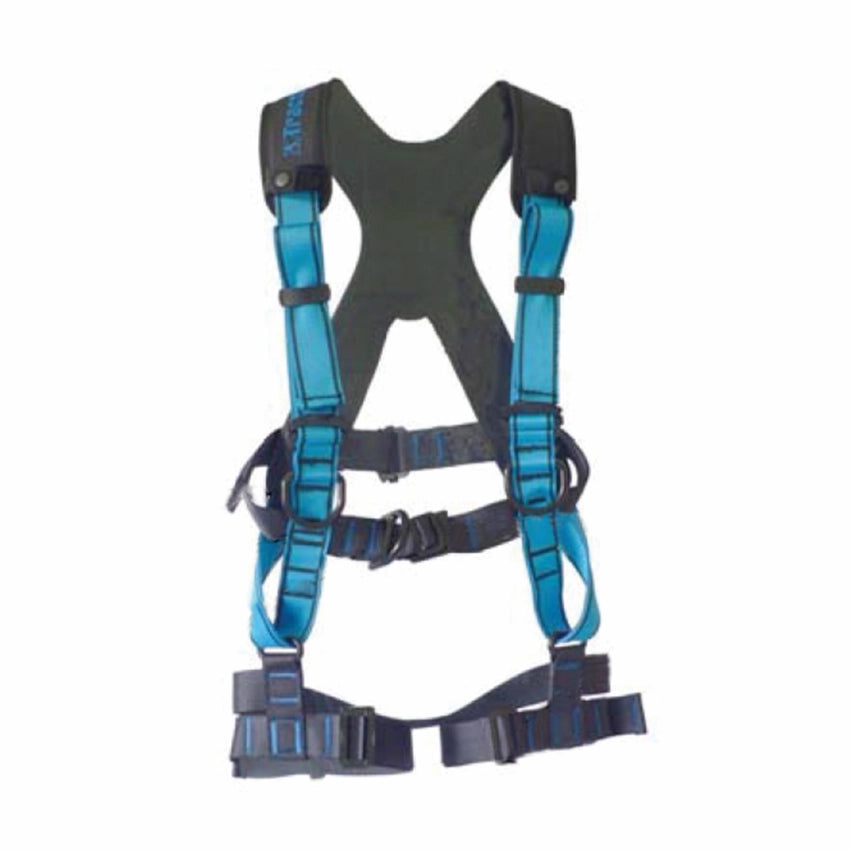
Example of a fall arrest harness
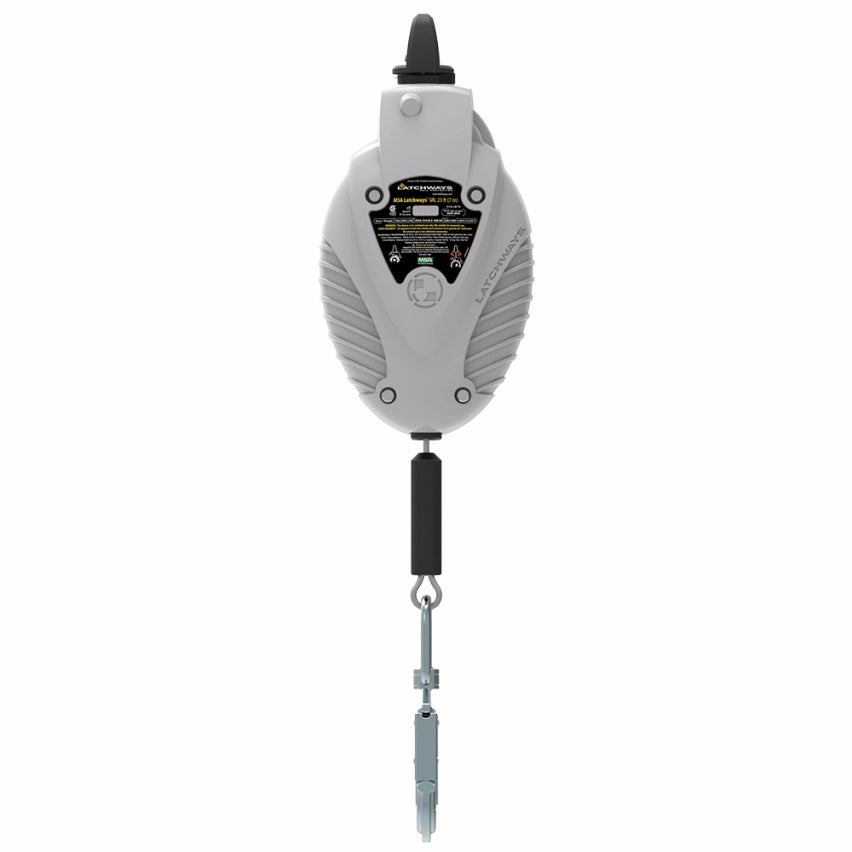
Example of a retractable lifeline
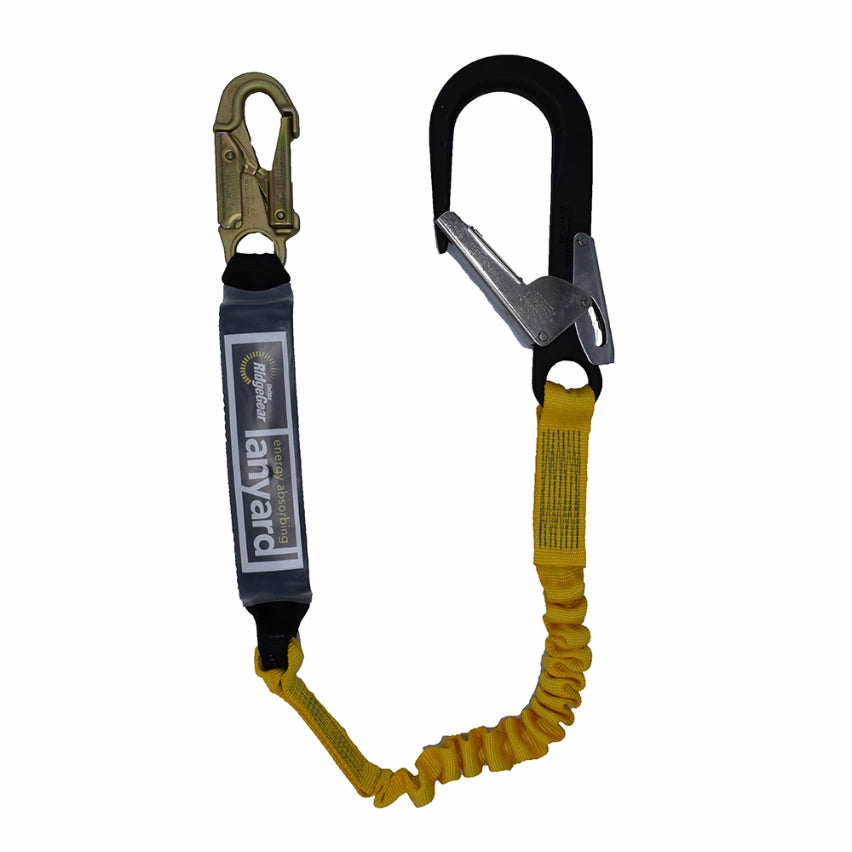
Example of a fall arrest
