

More about wire rope clamps
Below we have collected more information about our selection of wire rope clamps. You can read more about the individual types and get specific tips and tricks for installation.
Are wire rope clamps approved for lifting?
As a general rule, wire rope clamps are not approved for lifting, but there are exceptions, and you can use our filtering option to find the selection of wire rope clamps that are approved for lifting. An example of wire rope clamps approved for lifting is E-Grip, where up to and including 16 mm steel wire rope two E-Grip wire rope clamps are used per joint, and from 17 mm and up one E-Grip wire rope clamp is used per joint.
How are wire rope clamps installed?
It is always recommended that wire rope clamps are re-tightened after the first load and that you also carry out regular checks under load. It is also strongly recommended that installation is carried out in accordance with the instructions for use of the individual wire rope clamp. There may be different requirements for the number of wire rope clamps per joint, e.g. the distance between the individual wire rope clamps. You can see specific instructions for installing U-bolt wire rope clamps in the following section.
U-bolt wire rope clamps
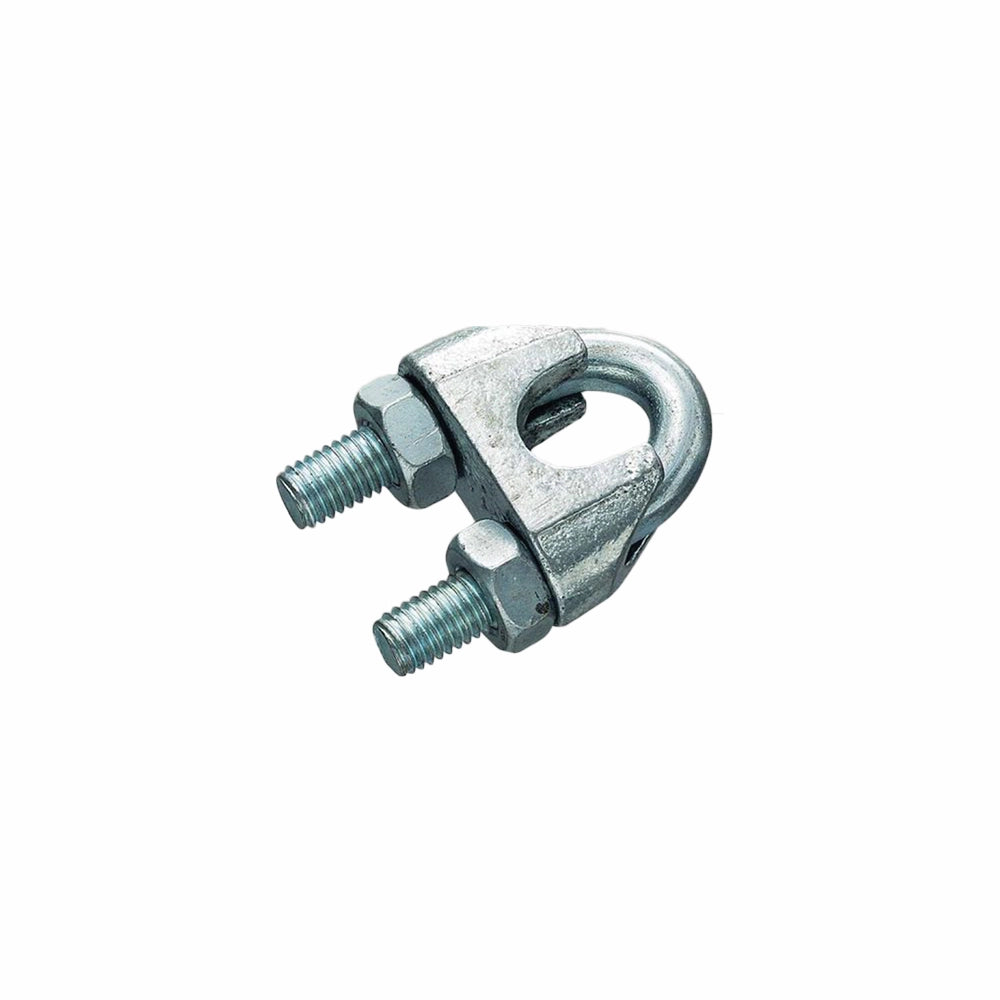
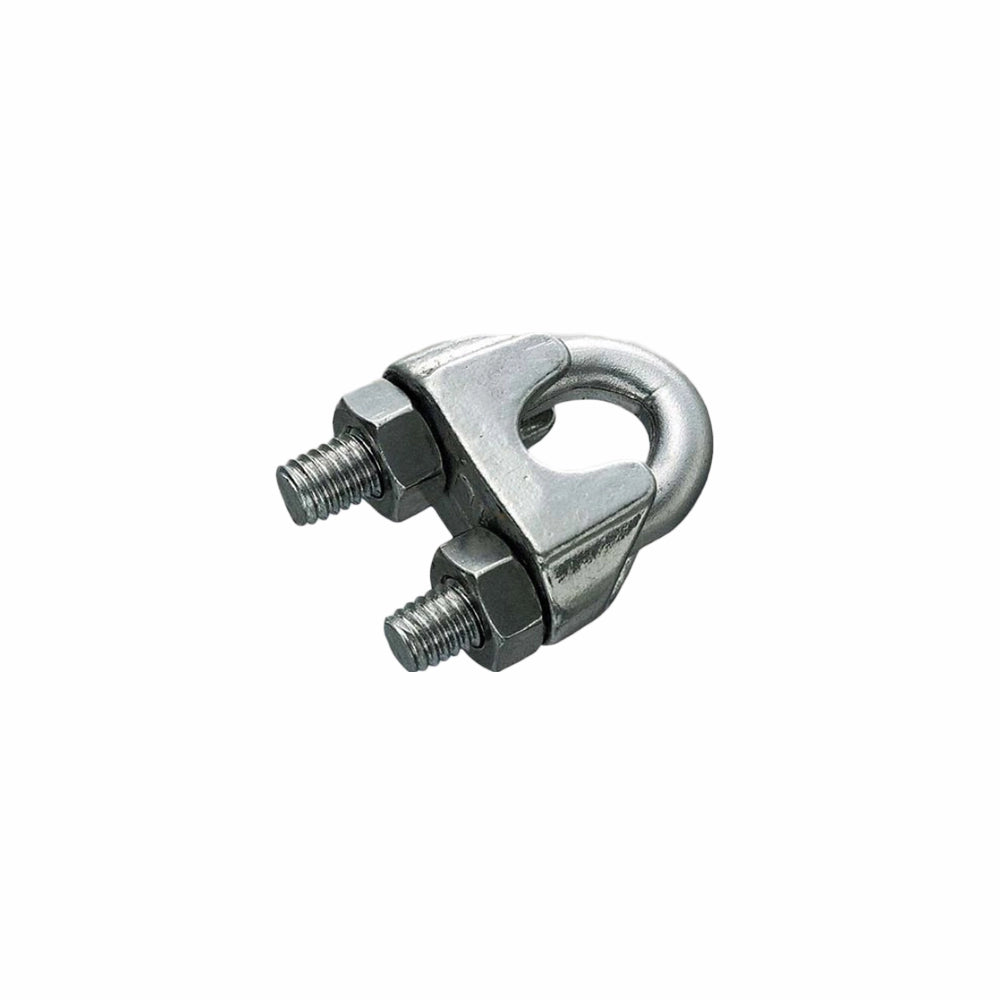
U-bolt wire rope clamps according to DIN 741 are our 'best-seller' and are available in both a galvanised and a stainless version. When you use U-bolt wire rope clamps, there are a number of requirements for the number per eye and the distance between each wire rope clamp. For steel wire rope with a diameter from 3 up to and including 15 mm, 3 pcs. are used per eye. From 16 up to and including 30 mm, 5 pcs. are used per eye. From 31 mm and up, 7 pcs. are used per eye.
The distance between the wire rope clamps must always be 6 x the wire rope diameter.
IronGrip wire rope clamps
In our range you will find two different types of wire rope clamps from IronGrip:
BG-S: The ideal wire rope clamp for smaller steel wire ropes up to 6 mm in diameter. A single BG-S wire rope clamp holds the breaking strength of the steel wire rope and takes up minimal space – while being easy to install.
BG-100: This type of wire rope clamp meets the requirements of EN 13411-3. In addition, it is designed not to damage the steel wire rope, and as a rule fewer wire rope clamps can be used. 2 pcs. BG-100 wire rope clamps must always be used per eye, regardless of wire rope diameter, and each type covers several wire rope diameters.
Wedge sockets
Wedge sockets are approved for lifting and can also be repositioned. Wedge sockets are available in a number of different designs. This type is used on e.g. mobile cranes, where there may be a need to adjust the length of the steel wire rope.
Wire rope clamps vs. Talurit ferrules
Unlike the vast majority of wire rope clamps, Talurit ferrules are a permanent type of clamp that is pressed onto steel wire rope and some types of fibre rope. Talurit ferrules are used for e.g. wire rope slings etc. The smallest sizes can be pressed with hand-held tools, but the vast majority of pressings carried out in our rigging workshops are done on hydraulic Talurit presses with special dies for each individual Talurit ferrule. There are many different Talurit ferrules, e.g. TKH in copper for stainless steel wire rope. You are always welcome to contact us for advice on Talurit ferrules.
Are there other wire rope clamps than those shown on this page?
Yes, not our entire range is shown on this page, but you are always welcome to contact us if you cannot find exactly the wire rope clamp you are looking for. As always, you can contact us on 7015 2015 or write to us at fku@fku.dk
How to install a wire rope clamp correctly
Correct installation of a wire rope clamp (also called a steel wire rope clip or wire clamp) is crucial for the strength and safety of the joint. An incorrectly installed wire rope clamp can reduce the breaking strength of the wire rope by up to 40%. Always follow these basic rules: 1. The U-bolt on the dead end: The U-bolt of the wire rope clamp must always be placed over the "dead" (short) end of the wire rope, while the saddle itself (the flat part) must rest against the "live" (load-bearing) part of the wire rope. A good rule of thumb is: "Never saddle a dead horse" – the saddle must never sit on the dead end. 2. Number of wire rope clamps: The number of wire rope clamps required depends on the thickness of the wire rope. As a rule of thumb, at least 3 wire rope clamps must be used for wire ropes up to 15 mm, and more for thicker wire ropes. Always refer to the manufacturer's instructions for the exact number. 3. Spacing: The distance between each wire rope clamp must be approximately 6 times the diameter of the wire rope to ensure even force distribution. 4. Re-tightening: When the wire rope is loaded for the first time, it will stretch and become slightly thinner. It is therefore critically important to re-tighten all nuts on your wire rope clamps after the first load.
